Urbanism and Urban Architecture
Buildings, cities, and regions shape the way we live. Well-planned and designed urban areas help communities thrive, and therefore urban planners and designers can make a real difference for people today as well as future generations.
At the UUA Chair, we focus on the future of cities: how to plan, design, and transform them to address the urgent challenges facing today鈥檚 urbanizing world. Our work bridges urban planning and design, from regional planning to public space design and building ensembles, and is grounded in interdisciplinary and transdisciplinary theories and methods from the fields of urbanism, critical urban studies, as well as futuring, innovation, and transition studies.
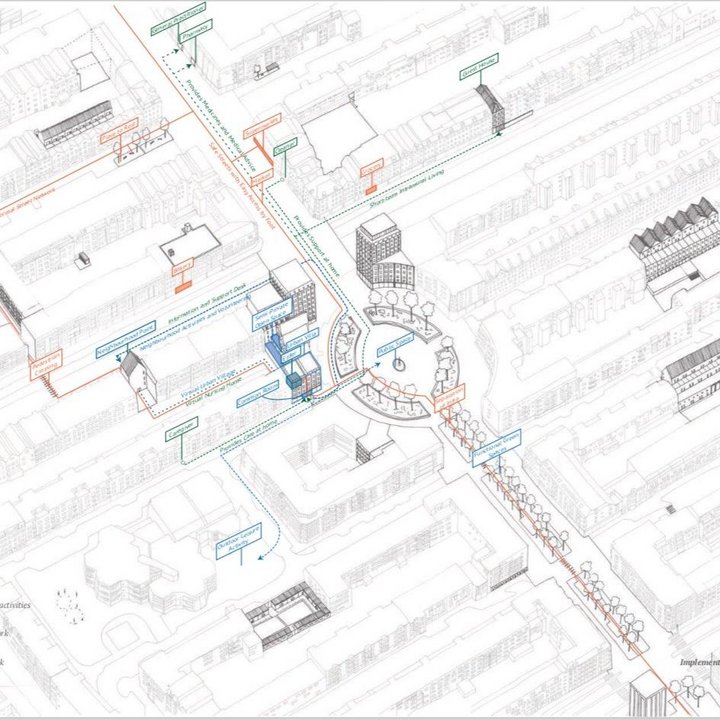
鈥淲e focus on the (trans)formation of cities and their architecture, anticipating systemic changes in society, economy, technology, ecology, and governance.鈥�
What We Do
We see urbanism as both a systems theory-based science and a transformative professional practice. This means:
- Studying how cities evolve under environmental, social, economic, technological and political pressures.
- Focusing on adapting existing urban areas through socio-technical innovations.
- Exploring urban form, from buildings and neighborhoods to entire regions, as expressions of complex socio-ecological systems.
- Using insights from urban morphogenesis, transition and futures studies, and social sciences to understand how cities are governed and physically reshaped.
Our methods range from qualitative research and ethnography to GIS, simulations, and VR experiments. We combine traditional approaches with cutting-edge digital tools.
Why It Matters
Urban challenges are particularly pressing in rapidly growing regions like the Metropolitan Region Eindhoven (MRE). Here, issues such as affordable housing, sustainable mobility, renewable energy, circular food systems, and resilient economies come together. These complex and interconnected challenges, so-called wicked problems, require a multi-actor approach to address them effectively.
The UUA Chair works closely with MRE stakeholders, bridging research, teaching, and practice to co-develop innovative solutions. While Eindhoven is our living lab, our research connects to global debates and international networks, ensuring local insights contribute to worldwide progress.
How We Work
We integrate research and teaching through a challenge-based, collaborative approach:
- UrbanLabs: where students and staff work with real actors on real challenges.
- Urban Development Initiative (UDI): research programs with PhDs, postdocs, and international consortia.
Our research agenda is guided by:
- Examining how urban form, townscape, and programming shape each other.
- Studying how global structures and agents affect the planning and governance of cities.
- Applying systems and transition theories to societal, ecological, and technological challenges.
- Critically translating global challenges into local solutions, building on existing social, spatial, and governance capital.
Key Research Areas

Healthy cities
Urban planning and design directly shape how we live, move, work, and interact. These everyday patterns influence not only individual well-being but also the health of our planet. Poorly planned cities can reinforce unsustainable consumption, pollution, and sprawl, while well-designed ones can promote healthier lifestyles, cleaner environments, and social equity.
At UUA, we see health as both an input and an outcome of planning and design. Our goal is to create urban environments that encourage long-term, structural improvements for both people and ecosystems.
We investigate:
- How the form and design of cities influence human behavior, health, and equity.
- Socio-spatial interventions such as street and land use planning, interactive playgrounds, and digital tools that encourage healthy behavior.
- Planetary health approaches connecting urban food systems, climate adaptation, and rural-urban interactions.
- The needs of vulnerable groups, including children, young and older adults.
By combining health promotion theories, behavior change science, and urban design, we test and evaluate effective interventions. With the support of digital technologies, we integrate health into all stages of planning: from visioning and modeling to implementation and monitoring.
Nature-inclusive Cities
Technical, sector-based approaches to urban planning no longer suffice to address challenges such as climate change, biodiversity loss, and environmental decline. This research line aims for a future where urban growth and ecological resilience go hand in hand.
We advocate for a systems approach, bringing together diverse stakeholders, human and non-human, to co-create resilient, adaptable urban environments. By bridging sectors and disciplines, we imagine spatial explorations that integrate water, soil, biodiversity, and human activity into sustainable urban living.
We investigate:
- Climate-resilient cities: How adaptation to drought, flooding, and heat can also improve livability and quality of life.
- Ecological transition and nature-inclusive practices: Exploring commons, participatory design, and more-than-human perspectives in neighborhoods.
- Rural-urban transitions: Reframing urbanization by studying landscapes historically, testing alternative land uses, and reconnecting rural and urban systems.
Our work uses multi-scalar approaches, from regions to neighborhoods to individual buildings, and emphasizes evidence-based practice. Through scenario building, backcasting and prefiguration, we define practical steps toward resilient, nature-inclusive futures.


Inclusive cities
The Inclusive Cities research line asks: How can we build fair, livable, and resilient cities within planetary boundaries? We focus on transformative urban strategies that prioritize justice, equity, and well-being, especially for those whose voices are often overlooked.
Housing is central. In a time of shortages, financialization, and increasing precarity, we study how policy frameworks, design cultures, and community practices shape daily life and access to shelter. Our work bridges the private and the collective, exploring how homes and neighborhoods can be reimagined as spaces of resilience and solidarity.
We investigate:
- Dwelling practices and placemaking: How individuals and communities create a sense of identity, belonging, and well-being through space, culture, and nature.
- Sharing practices and new living concepts: From co-living and student housing to intergenerational and refugee accommodations, exploring how shared living fosters inclusivity, resilience, and sustainable use of space.
- Seeds of hope: Everyday practices and urban commons that point to post-growth futures.
By drawing on planning, urban sociology, and geography, we contribute to broader debates on just urban transitions and collaborative planning, informing policies and designs that create equitable urban futures.
Resilient Cities
Cities are not static 鈥� they are shaped by layers of history, culture, and community life. Our research on Resilient Cities takes a socio-temporal perspective, seeing historical urban landscapes (HULs) as key to adapting to today鈥檚 social, economic, and ecological challenges.
These landscapes hold both tangible assets (buildings, infrastructure) and intangible value (local knowledge, identity, cultural memory). Because of their adaptability and accessibility, HULs can host new social, cultural, and economic initiatives in more sustainable ways than new-build developments.
We investigate:
- Entrepreneurial practices and placemaking: How cultural, social, and economic actors co-create new working and living environments that encourage experimentation and innovation 鈥� while avoiding exclusion and gentrification.
- Public entrepreneurship and urban commoning: How citizens and communities pool resources to deliver public benefits, build livelihoods, and strengthen civic life.
- Innovation districts and incubators: How urban and architectural settings can facilitate inclusive and circular economies, while fostering identity, ownership, and collective organization.
This research line focuses on brownfields, central business districts, and institutional complexes as fertile grounds for renewal. By combining historical awareness with forward-looking strategies, we aim to balance continuity and change, supporting cities that are both rooted and resilient.

Meet some of our Researchers
Recent Publications
Our most recent peer reviewed publications
Contact
-
Postadres
Department of the Built EnvironmentP.O. Box 5135600 MB EindhovenNetherlands