Humans and Technology
Understanding the relation between humans and technology is key to responsible development and acceptance of future technologies in almost every application field, be it energy, mobility, health, work, living, learning or entertainment. From a disciplinary perspective this relation involves the social sciences & humanities and the engineering disciplines. Connecting them is crucial for future innovation and those companies and research centers that will be able to build those bridges will have a crucial competitive advantage.

Our Mission
We focus on human-centered and value-sensitive approaches to technology understanding and design.. We investigate how different technologies can impact human mind, behaviour, and values, as well as how technologies should be designed for effective, sustainable, and responsible interaction with humans at individual, interpersonal, organizational and societal levels.
Our expertise is unique in terms of its potential to translate and apply deep social scientific knowledge and methods from psychology, philosophy and ethics. We contribute to scientific insights and design methods that shape technological innovations, and help assess effects and implications of modern technology on human mind and behavior.
Our research topics


Flashback on events
An overview of past events organized by and in cooperation with the Center for Humans & Technology
Adaptive and engaging technologies
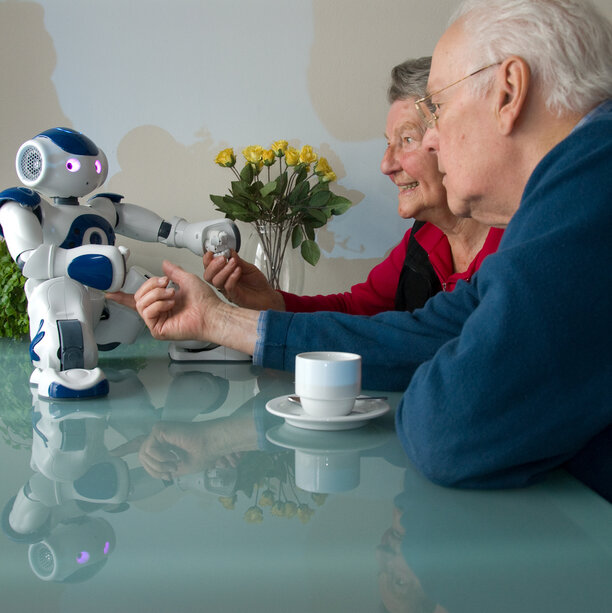
Future technologies need to be based on human needs and values at a personal, organizational and/or societal level. They will have to adapt their functionality to maximize these needs and values, and in some applications fields will have to engage humans at these different levels. This is one of the conditions for their successful adoption and diffusion.
Examples of adaptive and engaging technologies that currently have scientific interest are technologies aimed at behavioral change, health and well-being, life-long employability, or a sustainable society. The development of these technologies should take into account that human needs and values vary across cultures and regions, and that the creation and implementation of these technologies has become more and more a complex multi-actor process.
The core methodology for this research approach is user-centered design with iterative cycles of designing new technology and evaluating the related human values through experimenting in a controlled lab setting or in the wild.



Understanding the impact of technology on humans and society
We need to understand better how past technologies have fundamentally changed human existence, and how future technologies may impact human beings and their society. This refection will help to design technologies with maximal value and minimal friction in a responsible way.
Research questions related to this theme are: How will a robotized world impact people? What will be the consequences of cognitive human enhancement? What can we learn from past failures in technology adoption? And how did our technological choices in the past affect our current societal challenges?
Common methodologies for this research theme are related to modelling humans from a psychological, economical, historical, philosophical, ethical and transition perspective, based on a combination of reviewing existing literature and experimenting in the wild.
Both research approaches should not be interpreted as independent of each other; they interact via feedback loops. Understanding the impact of technology on humans and society leads to improved adaptive and engaging technologies, where the impact of these improved technologies on humans and society needs to be analyzed. Ultimately such cycles should lead to optimized technology, implemented in a responsible and acceptable way.鈥�
Meet our board

鈥淒espite the increasing reliance on technology in our society, in my view, the key to designing a different future is to focus less on technology and engineering, and far more on the humanities and the design arts.
This is not a paradox. Technology certainly is a catalyst and will play an important role in what is to come. However, the deep issues holding back progress are more social and behavioural than technological. The skills of the engineer alone are simply not adequate to anticipate, much less address the relevant issues facing us today.
Hence, fields such as sociology, anthropology, psychology and industrial design, must be at least equal partners with engineering and technology in framing how we think about, design and manage our future.鈥�
Bill Buxton, Principal Researcher
Microsoft Research, 黑料福利网 Honorary Doctor
Contact us
-
Secretary
Anita Nellissen -
Marketing & Communications
Marc Rosmalen -
Postadres
Postbus 5135600 MB Eindhoventhe Netherlands -
Bezoekadres
ATLAS-building 9.401Groene Loper5612 AS Eindhoventhe Netherlands