4LM20 - Soft materials processing (R)
Content
Soft Materials encompass a wide range of materials such as polymers and multiphase materials like suspensions, emulsions and foams. These materials usually display complex flow behavior owing to their mechanical (rheological) properties, which is in turn a consequence of their inherent microstructure. Processing these materials is ubiquitous in several areas of application and often entails many challenges.
Polymers have very attractive properties for use in all kinds of products. For example, they have a low density but also good mechanical, optical and, recently, electrical properties (solar cells, polymer electronics). Designers have great freedom in shaping their products. Since polymers consist of long-chain molecules they are very stretchable leading to unique products, for example fibers made by spinning, which have a strength ten times larger than steel. The obtained properties are directly related to the process the polymer has undergone. Due to the long-chain structure some disadvantages also exist, such as a high viscosity demanding special manufacturing processes. In the end, the final properties of the polymeric product are determined by the full thermo-mechanical history during forming.

Multiphase materials are widely utilized in a multitude of food, personal care and pharmaceutical products. The presence of suspended particles/droplets/bubbles in a liquid continuous medium can give these materials interesting mechanical properties, such as viscoelasticity and a yield stress i.e. a minimum stress that is required to make these materials flow, both of which will affect how these materials are processed. Think for instance the packaging of food products such as mayonnaise or cosmetics such as body lotion or shaving foam. Medication is often made by an extrusion process of a suspension of solid particles and requires precise control of processing to ensure accurate dosage of the active ingredients. Another example is 3D printing of customized food for people with dietary restrictions, in which processing needs to be adjust on demand.
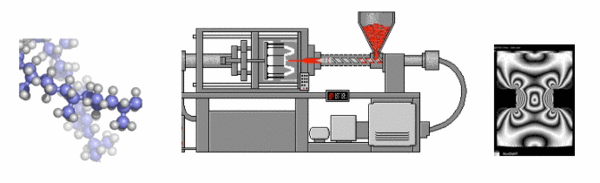
This course discusses the major concepts involved in the processing of soft materials. We describe the processing methods involved in the manufacturing of plastic products and then draw analogies between the processing of polymers and the processing of other soft materials of more complicated microstructure. Conventional processes like extrusion, mixing, injection moulding and blow moulding are covered, but also the basics of newer methods like 3D printing, electro spinning, and roll-to-roll printing are taught.

Objectives
- Fundamental insights into the processing of different classes of soft materials for various types of applications. At the end of the course, the student can:
- Remember and identify different classes of soft materials;
- Understand how the underlying microstructure affects the rheological behavior of soft materials;
- Identify different types of non-Newtonian flows present in complex processing conditions and apply this knowledge to calculate flow solutions;
- Understand and describe the concepts of extrusion-based methods and different 3D printing principles;
- Understand and explain the concepts of distributive and dispersive mixing, and describe the working principles of static and dynamic mixers;
- Understand and describe the basics of processes such as injection moulding, blow moulding, extrusion;
- Identify how processing windows are related to microscale phenomena, such as the onset of different elastic instabilities and flow induced crystallization;
- Understand and describe the working principles of different characterization techniques and interpret simple output data.
- Critically analyze a scientific article in the field.
Contact
- dr. Alexandra Alicke (R)
- dr.ir. Stan F.S.P. Looijmans
- dr. Manolis Chatzigiannakis
- prof.dr.ir. Patrick D. Anderson
R - Responsible lecturer