4RC00 - Structure and flow (R)
Content
During the design of a product not only the material properties and process conditions should be taken into account but also the interactions between both. In this course, a framework will be developed that allows the student to set up the balance and constitutive equations and to identify the relevant terms in these equations.
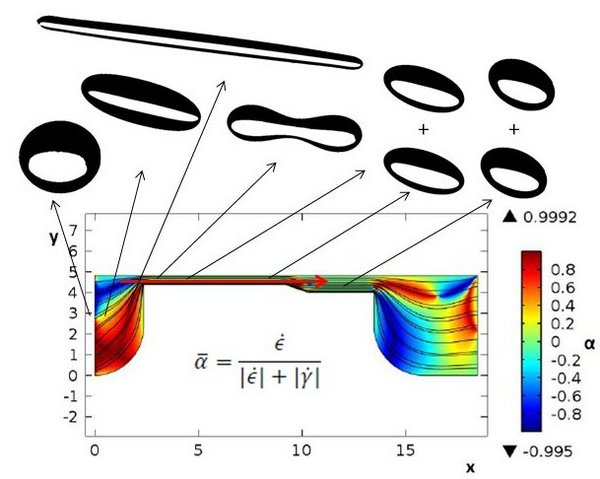
In addition, the basic concepts of rheology, the subject that deals with the quantification of material behavior as a function of deformation, will be introduced. An overview will be given of the most prevalent measurement devices and analysis techniques that allow to determine the characteristic parameters in the constitutive equations. This will provide the student with the relevant practical background in measuring flow properties of materials complementary to the analytical approach. Many fluids encountered in industrial applications have a yield-stress. Hence, we extensively treat viscoplastic and elastoviscoplastic fluid models. Most processing operations involve multiple components, separated by interfaces, rather than simple single phase fluids. Hence, the basis of the rheological behavior of emulsions and suspensions of (deformable) particles will be discussed. Finally, the developed framework will be illustrated by means of applications such as sorting of soft particles (or cells) based on their rheological properties and the properties of the surrounding fluid in passive microfluidics. A further coupling between theory and application will be provided by means of numerical assignments.
Learning objectives
- The students can give a mathematical description of isothermal flow problems by means of mass and momentum balances, boundary conditions and constitutive equations
- The students can apply scaling methods to identify the relevant terms in balance equations, constitutive equations and boundary conditions
- The students can calculate analytical solutions for simple processing flows of (non-Newtonian) viscous materials
- The students can explain the main concepts and techniques in rheometry and rheology and can design and analyze simple rheological measurements
- The students can use preprogrammed TFEM codes to solve flow problems of elastoviscoplastic materials and can interpret the results
- The students can describe the relevant physics of the deformation of soft particles in flow
- The students know the main relations between flow, structure and rheology in suspensions of (deformable) particles and can use this knowledge for particle separation based on structure and rheology in passive microfluidics
Contact
R - Responsible lecturer