Group Remmers
Our research group studies the mechanical properties of complex, engineered materials such as fibre reinforced composites and 3D printed materials for lightweight automotive and aerospace applications. In addition, we investigate the mechanical behaviour and fluid flow in fractured porous materials. In all these cases, we develop novel numerical techniques using our own in-house developed Finite Element codes.
Research Profile
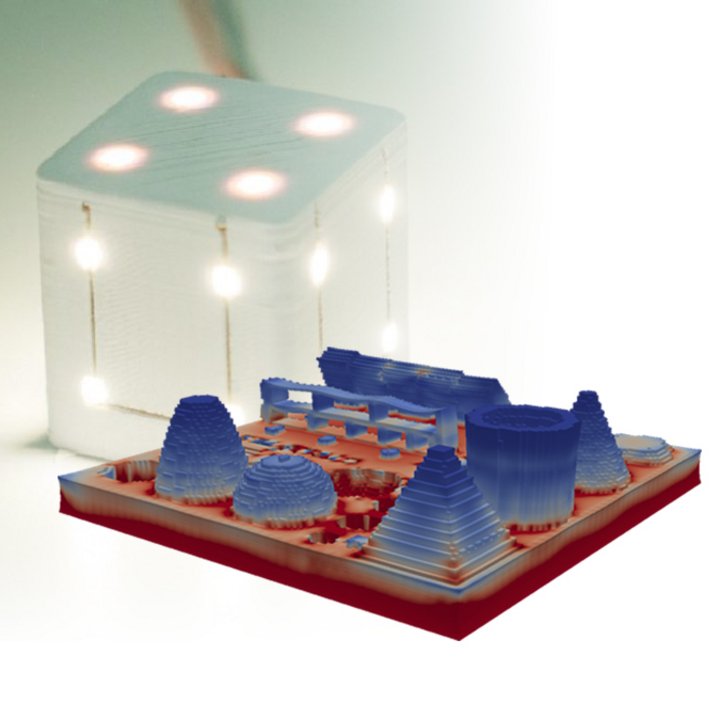
The performance of engineered materials such as composites and 3D printed materials can be improved significantly by studying the evolution of their complex microstructures using advanced numerical techniques.
WORK WITH US!
The Mechanics of Materials section posts new positions throughout the year.
Check our for our current scope of research.
Meet some of our Researchers
Former PhD students supervised
Research themes

Student opportunities
Education is at the heart of our research group. We are offering bachelor and master courses, bachelor and master thesis projects and internship projects.
Software
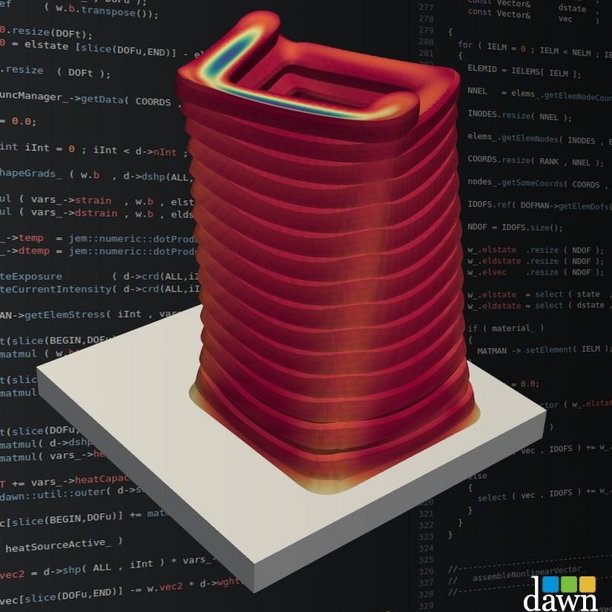
In order to develop new numerical technique, an in-house developed software platform is a prerequisite. In our research we therefore make extensive use of our own software tools: Dawn and PyFEM. Dawn is our working horse. The development of this C++ finite element code was started in 2002 and now comprises of a variety of element formulations, materials and solver techniques, most of which are not available in commercial or open-source codes. Dawn is built using the Jem-Jive libraries that are developed by Erik Jan Lingen (Dynaflow).
Specific advanced numerical techniques that are incorporated in Dawn are:
- The partition of unity method (X-FEM)
- Isogeometric Analysis using the Bezier Extraction technique
- Model Order Reduction techniques and Wavelet integration
- Simulation of Additive Manufacturing processes
- Discrete Dislocations
PyFEM is a small open source finite element code, written in Python 3.0 that we mainly use for prototyping new algorithms and in our educational program. PyFEM was originally developed to accompany the book:
R. de Borst, M.A. Crisfield, J.J.C. Remmers and C.V. Verhoosel
Non-Linear Finite Element Analysis of Solids and Structures
John Wiley and Sons, 2012, ISBN 978-0470666449
The entire code can be downloaded from the .
Past events
Recent Publications
Our most recent peer reviewed publications
Contact
-
Visiting address
Gemini South 4.130 (Building 15)Groene Loper5612 AP EindhovenNetherlands -
Visiting address
Gemini South 4.130 (Building 15)Groene Loper5612 AP EindhovenNetherlands -
Postal address
Department of Mchanical EngineeringP.O. Box 5135600 MB EindhovenNetherlands -
Postal address
Department of Mchanical EngineeringP.O. Box 5135600 MB EindhovenNetherlands -
Teamlead