Computational Materials Physics
The Computational Materials Physics group of Shuxia Tao works on the understanding of the process-structure-property-performance relationship of materials for energy applications. To do this, we develop and use multiscale methods, combining quantum methods e.g. Density Functional Theory with classical methods e.g. Molecular Dynamics, to study the complex interplay of chemistry and physics of materials at the nanoscale.
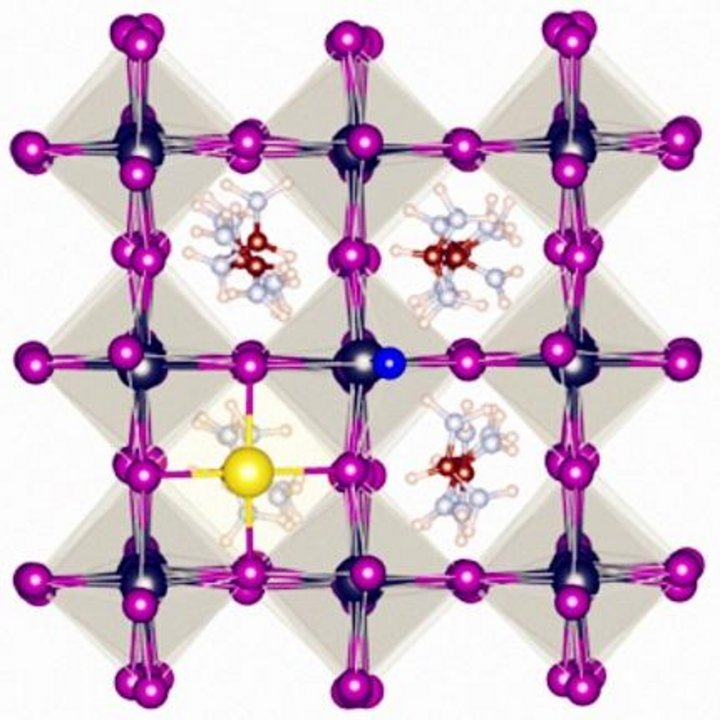
Simulating materials one atom at a time
We use Density Functional Theory based multiscale computer simulations to design materials for energy application. Our main focus is perovskite solar cells. Perovskite solar cells have emerged as one of the most promising photovoltaic technologies because of their potentially higher efficiency and lower cost than Si ones. The one remaining challenge is the long-term stability. The state-of-the-art cells are only stable for hundreds of hours. Ion migration as well as chemical reactions are key processes causing degradation. All the above processes are triggered and accelerated by the presence of intrinsic defects in the perovskite and extrinsic device operation stress, such as, thermal stress, light excitation and electrical bias.
Read moreImagine a future where light itself powers our devices 鈥� a crystal charging your smartphone, or one that doubles solar panel efficiency.
These semiconductors capture light and turn it into energy as excited electrons. To work best, they must absorb a broad spectrum of light and conduct charge efficiently.
Our research uses computer simulations accelerated by machine learning to predict and design such materials before they exist, accelerating the path toward devices powered directly by sunlight.
Research Methods
Our research integrates first-principles theory and methods with artificial intelligence to accelerate the discovery and design of functional materials for energy and information technologies.
Using advanced electronic-structure theory and methods, we link atomic structures, chemical and physical responses, and device performance. Machine learning extends this predictive framework to longer timescales, more complex materials, and richer physics beyond conventional simulations, while also strengthening connections to experiment.
This synergy allows us to uncover and control emergent quantum phenomena in semiconducting and optoelectronic materials, guiding their optimization for next-generation energy and information technologies.


Research Themes
Emergent optoelectronic properties in novel semiconductors
We investigate how light鈥搈atter interactions, defects, and phase stability govern the optoelectronic behavior of hybrid semiconductors such as perovskites. Our insights guide experimental strategies to improve stability and efficiency and inform industrial R&D toward scalable photovoltaics and LEDs.
Spin transport in chiral and quantum materials
We explore how chirality, symmetry breaking, and non-equilibrium effects drive spin-polarized transport. This research advances chiral-induced spin selectivity and spin-optoelectronics, enabling devices such as spin LEDs and chiral photodetectors, while uncovering how chirality shapes quantum coherence and information flow.
Spin electrochemistry for sustainable catalysis
We study how spin states in correlated, alter-magnetic, and chiral materials influence catalytic reactions in electrochemical systems. By combining spin transport theory, surface chemistry, and machine learning, we seek to enhance efficiency and selectivity in e.g., water splitting and CO鈧� reduction, laying the groundwork for spin-aware catalysts in sustainable energy technologies.
Student opportunities
We are constantly looking for enthusiastic and bright researchers at all levels (BSc, MSc and PhD and Postdoctoral). We invite motivated students to discuss with the PI and our for the latest research projects as the field develops fast and new exciting research questions emerge quickly.
The courses we offer are:
Advanced Materials Modelling using Multiscale Methods (3MQ110), Nanomaterials: Physics and Characterization (34NPC), and Fundamentals of Energy Harvesting and Storage (34FEH).

Meet some of our Researchers
Metal halide perovskites have been the focus of many computational studies over the past few years. The bulk of these investigations were done using methods based on quantum mechanics (QM). However, the computational cost of QM methods is high, limiting the investigation of the dynamical properties, as the materials are much 鈥渟ofter鈥� than traditional inorganic semiconductors. Such softness gives rise to unusual lattice dynamics and novel behaviors. All chemical and physical properties evolve and affect one another constantly under external stimuli (heat, light, electrical bias).
To capture the complex dynamical properties, we perform molecular dynamics (MD) simulations with several levels of efficiency. Ab-initio MD based on DFT, MD base on DFTB as well as MD based on force fields. We have recently developed a set of transferable and successfully applied it to simulate ion migration. To be able to simulate chemistry reactions during the degradation, we have extended our effort to reactive force field (ReaxFF). On the left-hand side, phase transition of a common perovskite (CsPbI3) under thermal stress is demonstrated using our newly developed .
Extensive methodology development is still required. Advances in machine learning algorithms and computational power have opened the way towards accelerated force field development as well as high-throughput screening.
From Materials to Devices
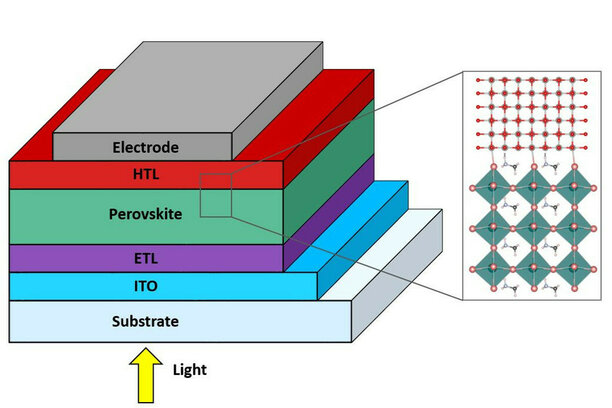
Perovskite solar cells have achieved an impressive power conversion efficiency of 25.2% in 2019. While its efficiency has become comparable with Si ones, their long-term stability are still far behind. Beside the perovskite absorbers, the interfaces between the perovskite and the charge transport layers are recognized as another important factor in determining both the efficiency and long-term stability.
Using DFT, we optimize energy level alignment in the whole devices, including those of charge transport layer, the perovskite absorbers, the electrodes. By or applying , better energy alignment can be achieved. We also study the roles of defects, and redox chemistry at several interfaces in the devices.
Our long-term ambition is to apply our multiscale approach to study dynamical properties that governs the long-term stability of the devices. Our goal is to design multifunctional interfaces combining the optimal optoelectronic properties with prolonged stability. Many inspiration of our research comes from our close interactions with experimental researchers at 黑料福利网 (PMP group) and knowledge institutes and industrial partners () .
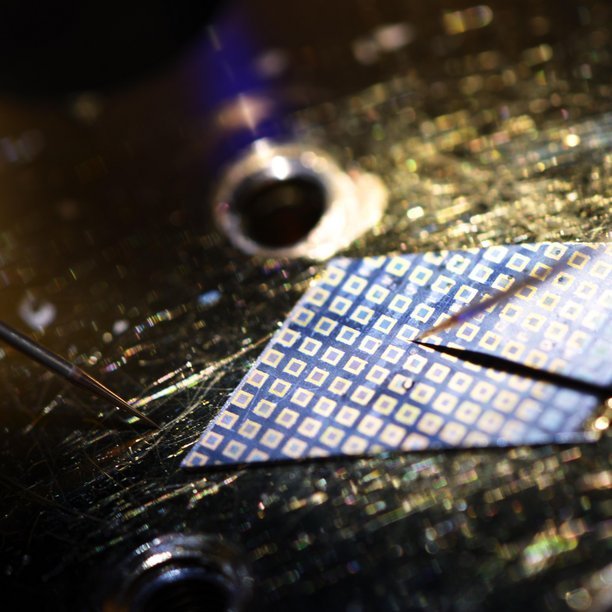
How 黑料福利网 technology brings the endless power of the sun to your home (and car)
The potential of solar power is enormous: our planet intercepts some 173,000 terawatts of radiation from the sun at any time, 10,000 times more power than the planet鈥檚 population uses. Harnessing this almost endless power source has been the driving force of much at the Eindhoven University of Technology. The research covers a broad terrain of expertise and interests, ranging from the elemental building blocks of solar cells and upscaling of technology to industrial production, to enhancing the aesthetics of solar panels or application in solar-powered cars. And with success: it is estimated that almost one third of all solar cells worldwide contain technology pioneered by our researchers. We take you step by step through the whole chain: from fundamental research in the lab to the application in everyday life.
News





Recent Publications
Our most recent peer reviewed publications
Contact
-
Visiting address
Cascade, room 3.12De Zaale5612 AJ EindhovenNetherlands -
Postal address
Department of Applied PhysicsP.O. Box 5135600 MB EinhovenNetherlands -
Teamlead
Teamlead