Cyber-Physical Systems and Systems Engineering
Cyber-physical systems to enable a smart, autonomous and connected world.
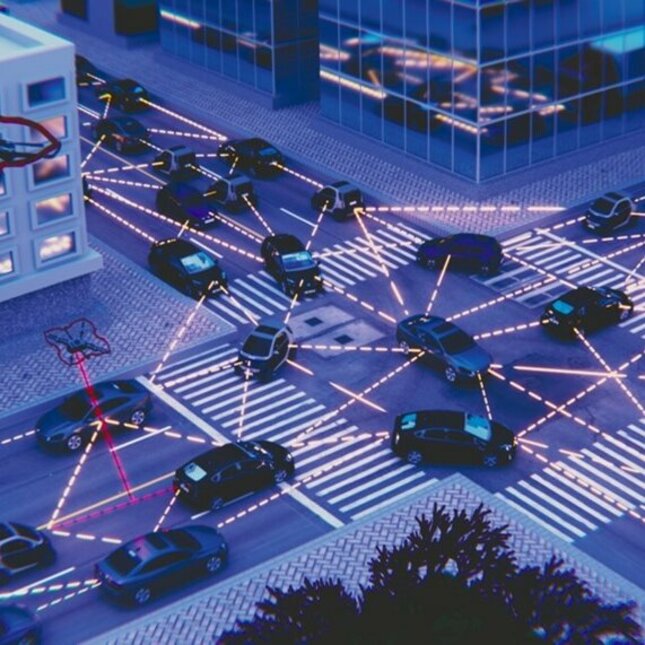
Cyber-physical systems (CPSs) integrate sensing, computation, control, and communication into physical systems, enabling them to interact intelligently with their environment and with each other. At CST, we develop the fundamental theories and tools that drive this transformation, shaping a new generation of smart, connected, and autonomous systems. These technologies are redefining key domains such as high-tech manufacturing, precision agriculture, autonomous mobility across land, air, and water, smart infrastructure, and personalized healthcare鈥攊ncluding advanced cancer treatment technologies.
The increasing complexity and connectivity of these systems demand a new level of integration across disciplines, combining mechanics, electronics, and software into unified design methodologies. At the same time, advances in artificial intelligence, machine learning, and digital twinning are accelerating innovation and opening up new possibilities for monitoring, control, and optimization. Addressing these challenges requires scalable, adaptive, and intelligent solutions that can operate reliably in dynamic and uncertain environments.
Our research focuses on uncovering fundamental principles for the analysis and design of complex, networked, and autonomous systems. By abstracting across application domains, we develop broadly applicable methods while maintaining strong connections to real-world challenges through collaborations with leading industrial partners such as ASML, NXP, TNO Automotive, Thermo-Fisher Scientific, and many others.
Hybrid Systems and Control
Cyber-physical systems inherently combine discrete decision-making with continuous physical dynamics. This results in hybrid system models that capture both logic-based behavior and physical processes. We develop advanced theories and tools for hybrid control, enabling high-performance and reliable operation in complex systems where traditional approaches fall short.
Large-scale and Networked Systems
Modern systems are increasingly distributed and interconnected, consisting of many interacting components. Our research addresses the analysis and control of such large-scale and networked systems, including multi-agent systems and systems operating over communication networks. Key challenges include scalability, robustness, and efficient coordination, with applications in autonomous vehicles, smart grids, robotics, and IoT.
Digital twinning and Learning
Digital twins provide high-fidelity virtual representations of physical systems, enabling advanced analysis, optimization, and control. These environments support data-driven and AI-based learning methods, allowing systems to be trained and tested safely and efficiently. By combining digital models with machine learning, we enable continuous adaptation and performance improvement in complex engineering systems.
Neuromorphic Control and Event-based Communications
Event-triggered control and communication reduce unnecessary data exchange by acting only when relevant changes occur, significantly improving efficiency, compared to conventional periodic time-triggered paradigms. Building on this, neuromorphic control introduces brain-inspired computation into control systems. Using spiking neural networks, these systems naturally process information in an event-driven manner, enabling low-latency, energy-efficient, and adaptive control strategies for future autonomous systems.
Supervisory Control
Supervisory control focuses on the coordination of complex systems to ensure safe and reliable operation. Using formal, model-based design methods rooted in discrete-event systems theory, we develop controllers that provide strong guarantees on system behavior, supporting correct-by-design engineering.
Systems Engineering
We develop model-based methods for the design and implementation of advanced engineering systems, particularly in high-tech manufacturing. By combining mechanical engineering with formal methods and computational tools, we create scalable and reliable design approaches that are validated in close collaboration with industry.
Projects
Research groups
The following research groups contribute to the research line.
FACULTY
PART-TIME FACULTY
-
Postal address
PO Box Postbus 5135600 MB EindhovenNetherlands -
Teamlead
Maurice Heemels -
Management Assistant Office